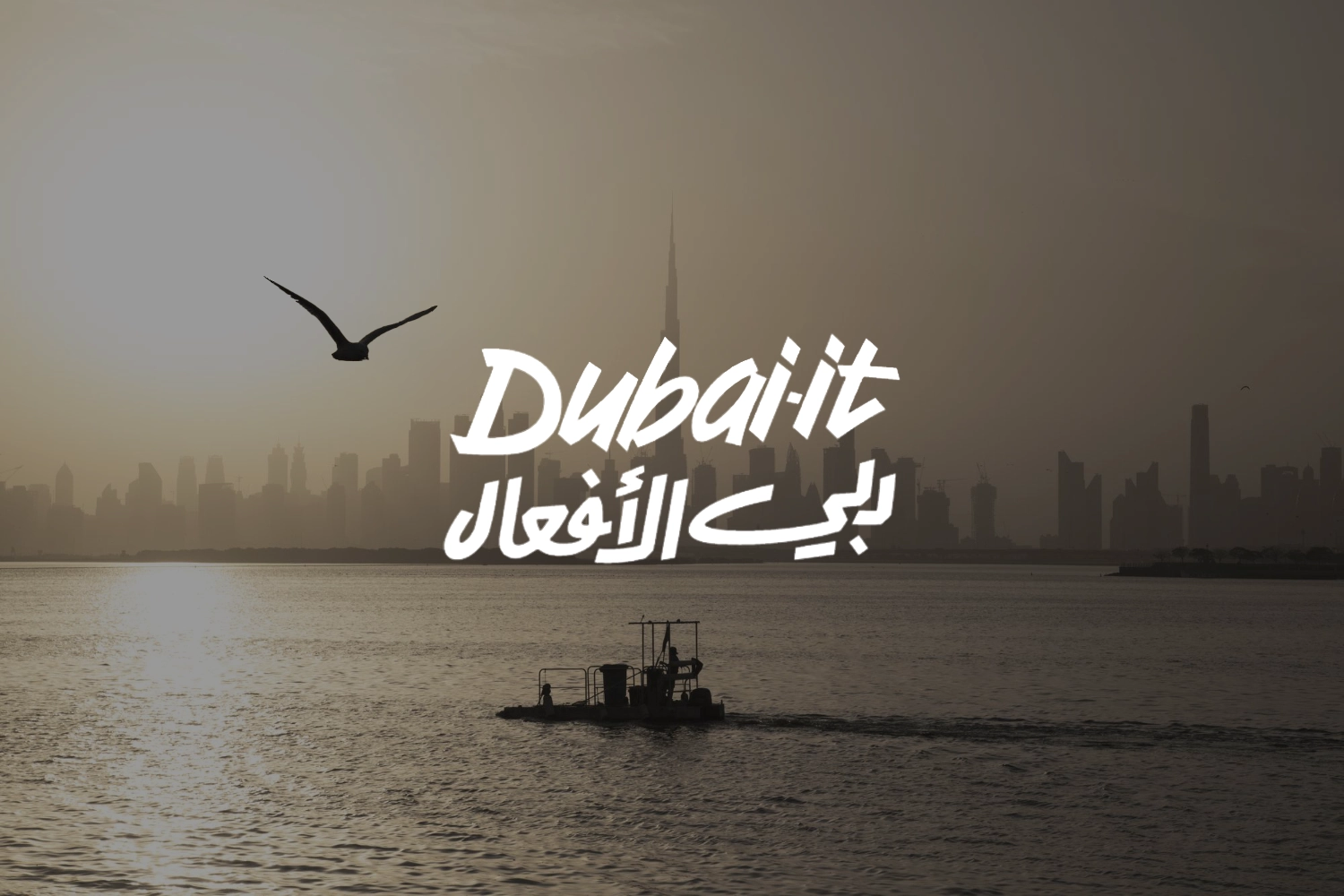
What Is “Dubai-it”? The New Verb Explained, And What It MeansFor Real Estate
If you have driven past a digital billboard in Dubai recently, or scrolled through local news, you
have probably seen the phrase “Dubai-it” popping up everywhere. It is not a typo and it is not a
random marketing slogan. Dubai has officially turned its own name into a verb, and there is a
real story behind why.
Where the word came from
In June 2026, His Highness Sheikh Mohammed bin Rashid Al Maktoum, Vice President and
Prime Minister of the UAE and Ruler of Dubai, introduced Dubai-it as both a philosophy and an
official verb. The announcement came with a short video showing him flying over the city
decades apart, first over empty desert, then over the skyline the world recognizes today.
By his own definition, to Dubai-it means to achieve something extraordinary with excellence in
record time. As he put it, speed does not mean haste, quality does not mean slowness, and
ambition has no value without execution. That line has become the closest thing Dubai has to
an official motto for how it wants to work, and how it wants the rest of the world to understand it.
Very few cities or brands ever earn the right to become a verb. Google became shorthand for
searching something online. Uber became shorthand for getting a ride. Now Dubai is aiming for
that same status, except instead of describing a product, the word describes a way of working.
The government has started weaving the mindset into leadership training programs, including
work led by the Mohammed bin Rashid Centre for Leadership Development, and a Dubai-it
Award has already launched to recognize individuals, institutions and projects that embody the
idea in practice, including one category built specifically around real estate projects that create
urban impact.
Why this matters beyond the branding
It is easy to read this as a clever piece of city marketing and move on. But if you actually look at
what Dubai has built over the last few decades, the word fits a pattern that was already there
long before it had a name.
Dubai went from a small trading town to a global city inside a few decades. The Palm Jumeirah,
the world’s largest man made island shaped like a palm tree, moved from construction starting
in 2001 to its first residents arriving in 2007. The Burj Khalifa was still under construction during
the 2008 global financial crisis, at a time when many analysts expected the project to be
abandoned. It was not. It opened in January 2010 and remains the tallest building on earth.
When Covid hit and the world shut down, Dubai reopened to tourism within three months and
went on to host Expo 2020, welcoming more than 24 million visits from 192 countries.
None of that happened by accident, and none of it happened slowly. That is the pattern Dubai-it
is now trying to put a name to.
What it means for the property market
This is where it gets genuinely useful if you are a buyer or an investor rather than just a curious
observer.
Dubai’s developers already operate on Dubai-it logic, whether or not they ever called it that. Off
plan projects here regularly move from announcement to handover on timelines that would take
far longer in most other markets, without the finished product feeling rushed or cut short on
quality. That is a distinction worth paying attention to, because speed without quality is a
warning sign, while speed built on planning and execution is exactly what Dubai-it is describing.
For a buyer, this philosophy translates into something practical. It means paying attention to
developers with a track record of hitting their construction and handover milestones, not just
developers with the most attractive brochure. It means understanding that ambition on its own, a
beautiful rendering or a big promise, has no value without execution behind it. And it means
recognizing that the property market you are stepping into was built by an entire city that treats
delay as something to be actively engineered out, not accepted as normal.
Dubai’s economy backs this up with real numbers. The city’s non-oil economy now represents
more than 95 percent of its GDP, an unusually diversified base for a Gulf economy. The Dubai
Economic Agenda D33 is aiming to double the size of the economy by 2033 through a wave of
transformational projects, real estate among them. None of that is only slogans and speeches. It
shows up directly in how fast neighborhoods get built, how fast infrastructure like new metro
lines gets delivered, and how fast a piece of desert can turn into a finished, livable community.
The bigger picture
Dubai-it is ultimately less about a single word and more about what that word is trying to protect,
a culture where big promises actually get delivered on. For anyone weighing a property
purchase in Dubai, that is not just a nice marketing story. It is a genuinely useful lens for judging
which developments, and which developers, are worth trusting with your money.
Frequently Asked Questions
Who introduced the word “Dubai-it”? Sheikh Mohammed bin Rashid Al Maktoum, Vice
President and Prime Minister of the UAE and Ruler of Dubai, introduced it in June 2026 as an
official verb and citywide work philosophy.
What does “Dubai-it” actually mean? By its formal definition, it means to achieve something
extraordinary with excellence in record time, combining ambition, speed, precision and
execution.
Is Dubai-it just a marketing campaign? It started as a public campaign, but it is being built
into government leadership training, institutional culture, and a dedicated award program, so it is
meant to function as an operating philosophy rather than a one time slogan.
How does Dubai-it relate to real estate specifically? The Dubai-it Award includes a category
for real estate projects that create urban impact, and the underlying philosophy of speed paired
with quality closely mirrors how Dubai’s property developers already approach off plan
construction and handover timelines.

Recent Posts
Ten Reasons Why You Should Work In Dubai Real Estate